Shipping Software for Small Business: 2026 Guide
ShipStation, Shippo, EasyPost, Sendcloud, Shippit and Shopify Shipping compared, with carrier discounts, hidden costs and a 21-day rollout plan.
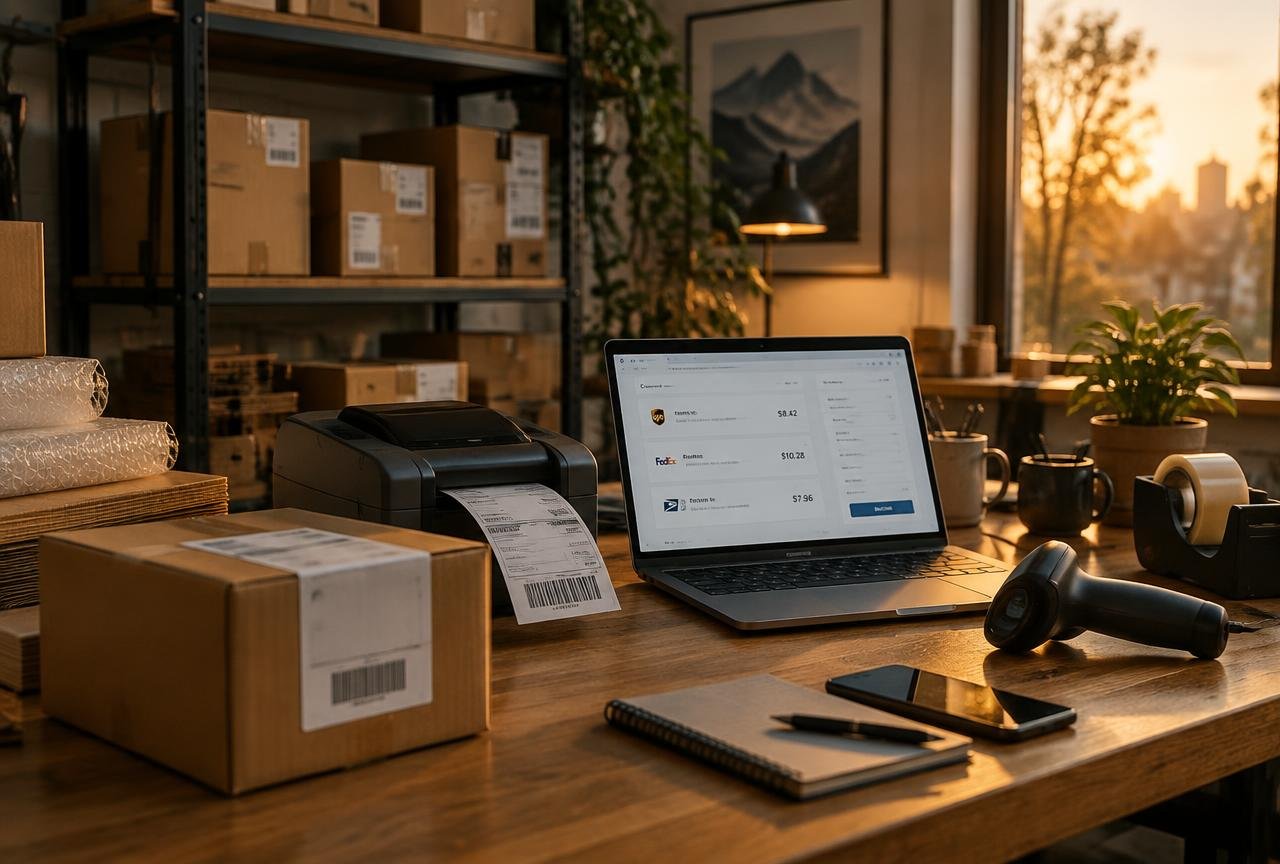
Shipping is the last thing a customer experiences and the first thing they complain about. It is also, for most small online sellers, the least controlled part of the operation: rates are guessed at checkout, labels are bought one at a time on a carrier website, tracking numbers are pasted into emails by hand, and the true cost per parcel only becomes visible when the monthly carrier invoice lands.
Shipping software — sometimes called a multi-carrier shipping platform or a label management system — sits between your store and the carriers. It pulls orders in, compares live rates across UPS, USPS, FedEx, DHL, Royal Mail, Canada Post, Australia Post and dozens of regional couriers, prints labels in batches, pushes tracking back to the customer, and tells you exactly what each shipment cost against what you charged.
This guide is written for merchants shipping anywhere between 50 and 5,000 parcels a month. It covers what the software actually does, how ShipStation, Shippo, EasyPost, Sendcloud, Shippit and the native tools in Shopify compare, how carrier rate discounts really work, what the hidden costs are, and a 21-day rollout that will not disrupt your dispatch schedule.
What shipping software actually does
A shipping platform is an orchestration layer. It does not carry your parcels; it decides which carrier should, at what price, with which service level, and it produces the paperwork. Everything else — the analytics, the branded tracking pages, the returns portals — is built on top of that core job.
The seven functions that matter
- Order ingestion — orders sync automatically from Shopify, WooCommerce, BigCommerce, Etsy, eBay, Amazon and your own checkout, with addresses validated before a label is bought.
- Rate shopping — live rates from every connected carrier account, compared side by side including surcharges, so the cheapest compliant service wins rather than the habitual one.
- Automation rules — "anything under 500g going domestic uses the economy service; anything over $200 in value gets signature on delivery" applied without a human deciding each time.
- Batch label printing — a hundred labels queued and printed to a thermal printer in one action, with packing slips and pick lists generated alongside.
- Tracking and notifications — status pulled from carriers and pushed to customers on your own domain, which cuts "where is my order?" tickets sharply.
- Returns — a self-service portal that issues return labels under your rules instead of a support agent emailing PDFs.
- Cost reconciliation — actual carrier charges compared with quoted rates, exposing dimensional weight adjustments and address correction fees.
Where it sits in your stack
Shipping software is downstream of stock and upstream of support. It reads the order, but it trusts your inventory system to have told the truth about what is on the shelf — if you have not solved that yet, start with our guide to inventory management software for small business, because a shipping platform will happily print a label for an item you cannot pick.
Downstream, tracking events are the single most common trigger for support contacts. Feeding them into your help desk software so agents see delivery status beside the conversation removes most of the back-and-forth that eats an agent's morning.
Eight signs you have outgrown manual shipping
- Someone logs into a carrier website and types addresses that already exist in your store.
- You charge flat-rate shipping because live rates at checkout were too complicated to configure.
- Your carrier invoice regularly exceeds what you expected, and nobody checks line by line.
- Tracking numbers reach customers late, or not at all, because emailing them is a manual step.
- Peak season dispatch requires an extra temporary hire mostly to print labels.
- You use one carrier for everything, including the routes where they are demonstrably expensive.
- Returns are handled by a support agent generating labels individually.
- You cannot state your average cost per parcel this month without building a spreadsheet.
Three or more of these and the maths is straightforward. A merchant shipping 400 parcels a month at roughly three minutes of manual handling each spends about 20 hours monthly on label work. Automation typically removes 70–85% of that, and rate shopping alone commonly trims 8–15% off postage on mixed domestic and international volume.
The two costs people forget
Dimensional weight. Carriers bill on whichever is greater: actual weight or volumetric weight derived from box dimensions. Ship air in oversized cartons and you pay for the air. Good shipping software stores box presets and warns you when a chosen carton is expensive for the contents.
Address corrections. Every carrier charges a fee for fixing a bad address, and those fees appear weeks later on the invoice. Address validation at the point of label creation is the cheapest insurance in e-commerce operations.
Best shipping software for small business: compared
The platforms below are the ones small merchants in the US, UK, Canada and Australia most often shortlist. Pricing reflects each vendor's published entry tier at the time of writing and changes regularly, as does regional carrier availability — confirm current figures directly before committing.
| Platform | Best for | Entry price | Own carrier accounts | Discounted rates | Main regions |
|---|---|---|---|---|---|
| ShipStation | Multichannel sellers with real volume | From ~$10/mo | Yes | Yes, negotiated tiers | US, CA, UK, AU |
| Shippo | Small stores wanting simple pay-per-label | Free tier, per-label fee | Yes | Yes | US-centric, some international |
| EasyPost | Developer-led custom workflows via API | Usage-based | Yes | Yes | Global via API |
| Sendcloud | European and UK cross-border sellers | Free tier, paid plans monthly | Yes | Yes | UK, EU |
| Shippit | Australian and NZ merchants | Quote-based | Yes | Yes | AU, NZ, SE Asia |
| Shopify Shipping | Single-channel Shopify stores | Included in plan | Limited | Platform rates | US, CA, AU, UK |
ShipStation
The default choice for merchants selling across several channels. Its strengths are automation rules, batch processing and warehouse-friendly features such as scan-to-verify and pick lists. It connects to a long list of marketplaces and carts, and you can bring your own negotiated carrier accounts alongside its platform rates. The trade-off is that the interface rewards configuration: an hour spent building automation rules pays for itself, but the tool is underwhelming if you never build them.
Best suited to
Sellers dispatching 200+ parcels a month across two or more sales channels, with someone willing to own the rules.
Shippo
Deliberately simpler. You connect a store, buy labels at discounted rates, and pay per label on the free tier or a flat monthly fee for higher volume. Returns and tracking pages are included. It is the most forgiving option for a store shipping 50–300 domestic parcels a month, and the fastest to get running — often under an hour from signup to first label.
EasyPost
An API-first platform rather than an application. If your operation has bespoke logic — split shipments across warehouses, custom carrier selection driven by your own margin data, labels generated inside an internal tool — EasyPost gives you the primitives. It is not the right choice if nobody on the team writes code.
Sendcloud
Built around European cross-border realities: local carrier mixes, parcel shops, customs documentation and country-specific returns expectations. UK sellers shipping into the EU after customs changes usually find its documentation handling noticeably better than US-centric platforms.
Shippit
Strong in Australia and New Zealand, where carrier coverage and regional delivery windows differ substantially from North America. It handles allocation across couriers such as Australia Post, Aramex and StarTrack, plus same-day services in metro areas.
Shopify Shipping
If you sell only through Shopify, ship domestically, and dispatch modest volume, the built-in tool may be enough. Rates are pre-negotiated by the platform, labels print from the admin, and there is nothing extra to pay. You outgrow it when you add a second sales channel, want to use your own carrier contract, or need conditional automation. Shopify documents its available services and regions on its own shipping help pages.

How carrier rates and discounts actually work
Understanding pricing mechanics is what separates merchants who save 15% from merchants who move their spending sideways.
Three ways to get a rate
- Retail rates — the published price anyone pays at a counter. Almost nobody online should be paying these.
- Platform rates — the shipping software has negotiated volume pricing across its whole customer base and passes a share to you. Excellent for small merchants; the discount is instant and requires no negotiation.
- Your own contract — you negotiate directly with a carrier based on your volume and profile, then connect that account to the software. Worth doing once you consistently ship several hundred parcels a month on predictable lanes.
Surcharges are where margin disappears
Base rate is rarely the final price. Expect fuel surcharges that move monthly, residential delivery fees, remote area surcharges, oversize handling, Saturday delivery, and peak-season charges in Q4. A platform that shows landed cost including surcharges at the moment of label purchase is worth more than one that quotes a tempting base rate and lets the invoice explain the difference later.
Charging customers correctly
You have three defensible strategies: live carrier rates at checkout, flat rates calibrated to your average cost, or free shipping funded by product margin above a threshold. Each works; mixing them carelessly does not. Track shipping revenue against shipping cost as its own line, monthly. If recovery sits below 80%, either your thresholds are wrong or your packaging is oversized.
Integrations, APIs and the systems that must agree
A shipping platform touches more systems than any other operational tool. Before you sign, confirm four connections in your own trial account rather than on a marketing page.
1. Sales channels
Every channel you sell on must sync orders in and tracking out. Test a real order per channel, including one with a discount code and one with two line items, because partial fulfilment behaviour differs sharply between integrations.
2. Inventory
Fulfilment must decrement stock in one authoritative place. If both your store and your inventory tool think they own stock levels, you will oversell within a month.
3. Accounting
Shipping spend should land in your ledger as a cost of sale, not as an unexplained card charge. Most platforms export a monthly statement that reconciles cleanly into QuickBooks or Xero; check the format during the trial.
4. Support
Tracking status inside the help desk turns a two-message exchange into a one-message answer.
When you need the API
Direct API work is justified when you split shipments across locations, apply margin-aware carrier selection, or embed label buying in an internal admin tool. Otherwise the native integrations will serve you better, because someone else maintains them when a carrier changes its endpoints. Carrier developer documentation, such as the UPS developer portal, is worth reviewing before committing to bespoke work.
International shipping, customs and compliance
Cross-border is where good software earns its subscription and bad process destroys margin.
Customs paperwork
Every international parcel needs a commercial invoice and a correct HS tariff code per item. Storing HS codes against products, rather than typing them per shipment, is the single highest-return configuration task in the whole setup. Errors here cause held parcels, unexpected duties and returns at your expense.
DDP versus DDU
Delivered Duty Paid means you collect duties at checkout and the customer receives the parcel with nothing to pay. Delivered Duty Unpaid means the carrier bills the customer on arrival — cheaper for you, and a reliable source of refused deliveries and one-star reviews. For consumer goods, DDP is almost always worth the complexity.
Country-specific realities
- United Kingdom — VAT registration thresholds and marketplace rules affect who remits tax on low-value consignments.
- European Union — IOSS registration simplifies VAT on consignments under the low-value threshold and speeds clearance.
- Canada — remote and northern postcodes carry substantial surcharges; check them before promising national flat rates.
- Australia — distances make zone-based pricing unavoidable; metro and regional costs differ enormously.
A 21-day rollout that will not disrupt dispatch
Do not switch everything on a Monday in November. Run the plan below in a quiet fortnight.
Week 1 — measure and choose
- Export three months of orders and calculate parcels per month, average weight, domestic/international split and top five destinations.
- Pull the last three carrier invoices and total surcharges separately from base rates.
- Shortlist two platforms that cover your channels and regions, and open trials on both.
- Buy five real labels on each, for your five most common parcel profiles, and compare landed cost.
Week 2 — configure
- Connect sales channels and confirm tracking writes back to each one.
- Create box presets with real dimensions and weights.
- Add HS codes to internationally sold products.
- Build three automation rules only: a domestic default, an international default, and a high-value rule requiring signature.
- Set up the branded tracking page and the customer notification emails.
Week 3 — run parallel, then commit
- Dispatch a full day through the new platform while the old process stands by.
- Check label print quality on your thermal printer, not a screenshot.
- Run one test return through the portal end to end.
- Switch fully, then review the first carrier invoice line by line against quoted rates.
What to measure afterwards
| Metric | How to read it | Healthy direction |
|---|---|---|
| Average cost per parcel | Total carrier spend ÷ parcels shipped | Down 8–15% within two months |
| Shipping cost recovery | Shipping revenue ÷ shipping cost | Above 80% |
| Labels per hour | Parcels dispatched ÷ dispatch labour hours | Up sharply after batching |
| "Where is my order?" tickets | Share of total support volume | Down after proactive tracking |
| Address correction fees | Carrier invoice line | Near zero with validation on |
Six expensive mistakes merchants make
1. Choosing on subscription price alone
A $30 monthly difference is irrelevant next to a 10% swing in postage. Compare landed label cost on your real parcel mix, not plan pages.
2. Never revisiting packaging
Dimensional weight means a slightly smaller carton can cut cost on every parcel forever. Audit your box range once a year.
3. Automating before measuring
Rules built on assumptions encode your existing mistakes at speed. Ship manually for two weeks with the platform recording data, then write the rules.
4. Ignoring the returns experience
Self-service returns reduce support load and increase repeat purchase rates. Treating returns as an afterthought is a growth decision, not just an ops one.
5. Hiding tracking behind carrier sites
A branded tracking page keeps customers on your domain, creates a merchandising surface, and reduces contacts.
6. Skipping invoice reconciliation
Carrier billing errors are common and rarely favour you. Review the first three invoices after switching, then spot-check quarterly.
Which platform should you choose?
Match the tool to your volume and geography rather than to a feature list.
- Under 100 domestic parcels a month, single channel: start with your platform's native tool or Shippo. Revisit when volume or channels grow.
- 100–1,000 parcels, multichannel: ShipStation is the safe default, particularly with negotiated carrier accounts connected alongside platform rates.
- UK and EU cross-border: Sendcloud, for customs handling and local carrier mixes.
- Australia and New Zealand: Shippit, for realistic regional allocation.
- Custom logic and in-house development: EasyPost as a building block, not an application.
Whichever you pick, the discipline matters more than the badge: validate addresses, store real box dimensions, let rate shopping decide, publish tracking on your own domain, and read the carrier invoice. Merchants who do those five things consistently outperform merchants who simply buy the more expensive platform.
If pricing and checkout economics are your next question, our comparison of e-commerce platforms for small business covers how each platform handles shipping rules natively.
Frequently asked questions
What is shipping software and how is it different from a carrier account?
A carrier account is a relationship with one delivery company. Shipping software sits above several carrier accounts, compares their live rates for each parcel, prints labels in batches, validates addresses, and pushes tracking back to your store and customers. You still ship with carriers; the software decides which one and handles the paperwork.
How much does shipping software cost for a small business?
Entry tiers commonly start free with a per-label fee, or around $10 to $30 a month for low volume, rising with parcels shipped and users. For most merchants the subscription is small relative to postage: a 10% improvement in average label cost usually dwarfs the plan fee within the first month.
Will shipping software give me cheaper postage rates?
Usually, yes. Platforms negotiate volume pricing across their whole customer base and pass discounts to small merchants who could not negotiate alone. Savings of roughly 8–15% on a mixed parcel profile are typical, and more if you were previously using a single carrier for every route.
Can I use my own negotiated carrier contract?
Most platforms let you connect your own accounts alongside their rates. That is the ideal configuration: your contract wins on the lanes you negotiated for, platform rates cover the exceptions, and rate shopping picks per parcel rather than per habit.
Does shipping software handle international customs paperwork?
Good platforms generate commercial invoices and customs declarations automatically, provided you have stored HS tariff codes and country of origin against your products. Doing that product data work once is what makes cross-border shipping smooth; skipping it causes held parcels and unexpected duties.
How long does it take to set up?
A simple single-channel domestic setup can be live in an afternoon. A realistic multichannel rollout with automation rules, box presets, customs data, branded tracking and a returns portal takes about three weeks, including a parallel-run day before you switch fully.
Do I need shipping software if I only sell on Shopify?
Not necessarily. Shopify's built-in shipping covers domestic dispatch at modest volume well. You outgrow it when you add a second sales channel, want to use your own carrier contract, ship internationally at volume, or need conditional automation rules the native tool does not support.
What is dimensional weight and why does it matter?
Carriers bill on the greater of actual weight or volumetric weight calculated from box dimensions. Shipping small, dense items in oversized cartons means paying for empty space on every parcel. Storing accurate box presets in your shipping software surfaces the problem before the carrier invoice does.
Can shipping software reduce customer support tickets?
Meaningfully. Proactive tracking notifications and a branded tracking page remove most delivery-status enquiries, which are typically the largest single category of e-commerce support contacts. Connecting tracking to your help desk resolves the remainder in one message instead of several.
E-commerce platforms, payment gateways, inventory and conversion tools for online sellers.


